From Returnable Bottles to the Circular Economy: A History of Glass Recycling in America
With America Recycles Day having just passed, it is a good time to look back at how glass recycling developed in the United States—and how the country’s understanding of recycling has changed over time.
Long before households had curbside bins, recycling apps, or lists of accepted materials, many Americans were already participating in a simple circular system: they returned empty glass bottles.
Stores collected them, bottlers washed them, and the containers went back into circulation. It was not called a circular economy at the time. It was simply how beverage distribution worked.
The history of glass recycling in America follows the country’s shift away from that return-and-refill model, the development of community recycling programs, and today’s effort to keep used glass in circulation as a valuable manufacturing resource.
Before Recycling Bins, There Were Returnable Bottles
Returnable glass bottles were once a normal part of American life. Consumers paid a deposit, returned the empty container, and received their money back. Bottlers then washed and refilled the bottles for another trip through the marketplace.
In 1971, approximately 36% of beer bottles and 53% of soft-drink bottles sold in Oregon were refillable containers. The system conserved packaging materials, but it depended on a more regional beverage industry in which bottles could be collected and returned to nearby bottling facilities.
As beverage distribution became more centralized and customized packaging became more common, one-way bottles and cans gradually replaced much of the refillable system. That shift made packaging more convenient, but it also changed what happened after a drink was consumed. A bottle that had once been returned for reuse was increasingly treated as waste. Learn more from the Oregon Department of Environmental Quality.
Glass Plants Were Recycling Before Communities Were
Even before postconsumer recycling became common, glass manufacturers were already reusing glass within their plants. Broken containers, rejected products, and other manufacturing scrap could be crushed and returned to the furnace as cullet.
Cullet was valuable because it could reduce fuel use and improve melting time. In-plant glass was especially useful because manufacturers knew its chemistry, color, and cleanliness.
This remains one of the most important distinctions in glass recycling today. Collecting glass is only the first step. To become a useful manufacturing input, recovered glass must be processed into clean, consistent cullet that meets the specifications of the plant receiving it. Historical EPA records provide additional context on the early use of cullet.
Community Glass Recycling Takes Shape
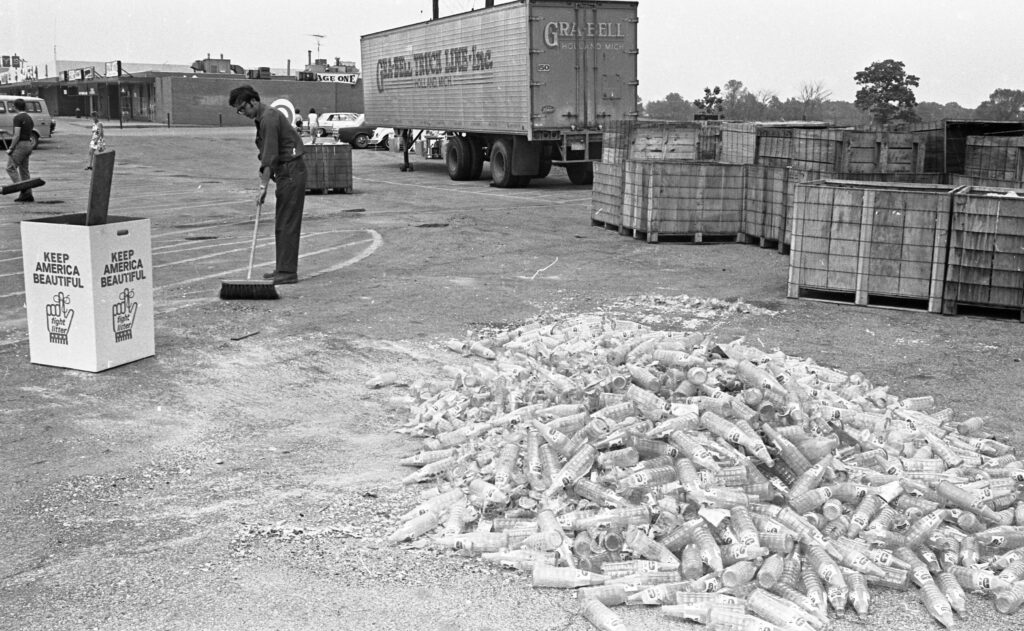
The late 1960s marked an important transition from recycling internal factory scrap to recovering bottles and jars from the public.
EPA records indicate that Owens-Illinois began community recycling projects in Bridgeton, New Jersey, in 1968. Industry-wide glass-recycling efforts followed in 1970, and by the end of 1974, the glass-container industry had recycled nearly 2 billion pounds of waste glass.
These early programs often relied on community groups, collection drives, drop-off sites, and residents willing to separate glass by color. They were not always efficient, but they proved that postconsumer glass could be collected and returned to manufacturing on a meaningful scale. View the EPA’s historical account.
1971: Oregon Passes the First Bottle Bill
In 1971, Oregon enacted the nation’s first bottle bill, creating a refundable deposit on covered beverage containers.
The original goal was largely to reduce litter along highways and in public spaces, but the law also created a direct incentive for consumers to return empty bottles and cans. Oregon’s legislation became a model for later state deposit-return programs.
Bottle bills demonstrated a principle that still matters in modern glass recycling: the design of a collection system affects both the amount of material recovered and the condition in which it reaches processors and manufacturers. Read more about the history of Oregon’s Bottle Bill.
Curbside Recycling Expands Across America
During the 1980s and 1990s, recycling became a more familiar municipal service. Communities introduced curbside pickup, public drop-off sites, and material recovery facilities. Glass bottles and jars became part of a larger recycling stream that also included paper, metals, and plastics.
EPA data show the scale of that growth. The United States recycled approximately 750,000 tons of glass in 1980. By 1990, that total had increased to approximately 2.63 million tons.
Curbside collection made recycling easier for millions of households, but convenience created new challenges. When glass is mixed with paper, plastics, ceramics, food residue, and other waste, it can break and become contaminated. The system may collect more material overall, but manufacturers still need that material to arrive in a usable condition. Explore the EPA’s glass recycling data.
America Recycles Day Begins
The first America Recycles Day was held on November 15, 1997. The campaign encouraged Americans not only to recycle but also to purchase products made with recycled material.
That second message is critical. Recycling does not end when an item enters a collection bin. It depends on processors preparing the material, manufacturers using it, and consumers supporting products with recycled content.
For glass, America Recycles Day is a reminder that bottles and jars are not simply waste to be managed. They are potential raw materials for the next generation of glass products.
The Modern Glass-Recycling System
Today, glass is collected through a patchwork of systems that varies by state and community. Some municipalities use single-stream curbside recycling. Others require residents to separate glass or take it to dedicated drop-off sites. Deposit states operate redemption programs, while restaurants, hotels, wineries, and other businesses may participate in commercial collection.
The latest national glass figures published on the EPA’s material-specific page are from 2018. That year, the United States generated approximately 12.25 million tons of glass in the municipal solid-waste stream and recycled approximately 3.06 million tons. About 7.55 million tons went to landfills.
Those numbers show both progress and lost opportunity. Glass can be recycled repeatedly without losing its basic material quality, but contamination from ceramics, stones, metals, heat-resistant glass, and mixed materials can prevent recovered glass from becoming furnace-ready cullet.
Why Cullet Matters to Glass Manufacturing
Cullet provides direct benefits inside a glass plant. Because recycled glass has already been melted once, it can require less energy to melt than a batch made entirely from virgin raw materials.
The Glass Packaging Institute reports that energy costs can decrease by approximately 2% to 3% for every 10% of cullet used in the manufacturing process. Cullet also reduces demand for sand, soda ash, limestone, and other raw materials. Learn more from the Glass Packaging Institute.
The value, however, depends on quality. A recycling program may collect a large volume of glass, but if that material is heavily contaminated or broken into unusable fragments, it may never return to a glass furnace.
A successful system must connect collection, sorting, processing, transportation, and manufacturing. Every step affects whether the material can become new glass.
From Recycling to a Circular Economy
A circular economy keeps materials in productive use for as long as possible instead of following a one-way path from extraction to disposal. Glass is well suited to that model: a bottle can be collected, sorted, processed into cullet, melted, and formed into another glass product.
But recyclability alone does not create circularity.
Communities need clear recycling instructions. Collection systems must limit contamination. Processors need the equipment and regional capacity to produce quality cullet. Manufacturers need reliable access to that material, and end markets must be strong enough to keep the system functioning.
The next chapter of American glass recycling may include more source-separated collection, stronger deposit-return programs, expanded commercial recovery, regional processing investments, and closer coordination between communities and glass manufacturers.
The Next Bottle Starts With the Last One
The history of glass recycling in America has moved from refillable bottles to disposable packaging, from community collection drives to curbside service, and from basic recovery efforts to a broader conversation about circular manufacturing.
Each stage solved one problem while revealing another. Returnable bottles demonstrated the value of reuse. Community programs proved that postconsumer glass could be recovered. Bottle bills created incentives for returns. Curbside systems made participation easier. Modern processing technology improved sorting and cleaning.
Glass recycling succeeds when a used bottle or jar does more than leave the household. It must make the full journey through collection and processing, return to a furnace as usable cullet, and become a new glass product.
That is the difference between managing waste and building a circular economy.
 JOIN GMIC