The Glass Behind American Innovation

At one point in the early automobile era, an estimated 33% to 65% of accident injuries were caused by flying glass. Today, the windshield in front of a driver is designed to crack while remaining largely intact. That transformation captures something important about glass: Americans have rarely stopped at simply making more of it. They have continually found ways to make it safer, stronger, clearer and more useful.
As the United States approaches its 250th anniversary, it is worth looking at the materials that helped move the country forward. Steel built railroads and skylines. Concrete supported highways and cities. But The Glass Behind American Innovation can be found almost everywhere—from kitchen tables and family homes to automobiles, defense systems, smartphones, communications networks and spacecraft.
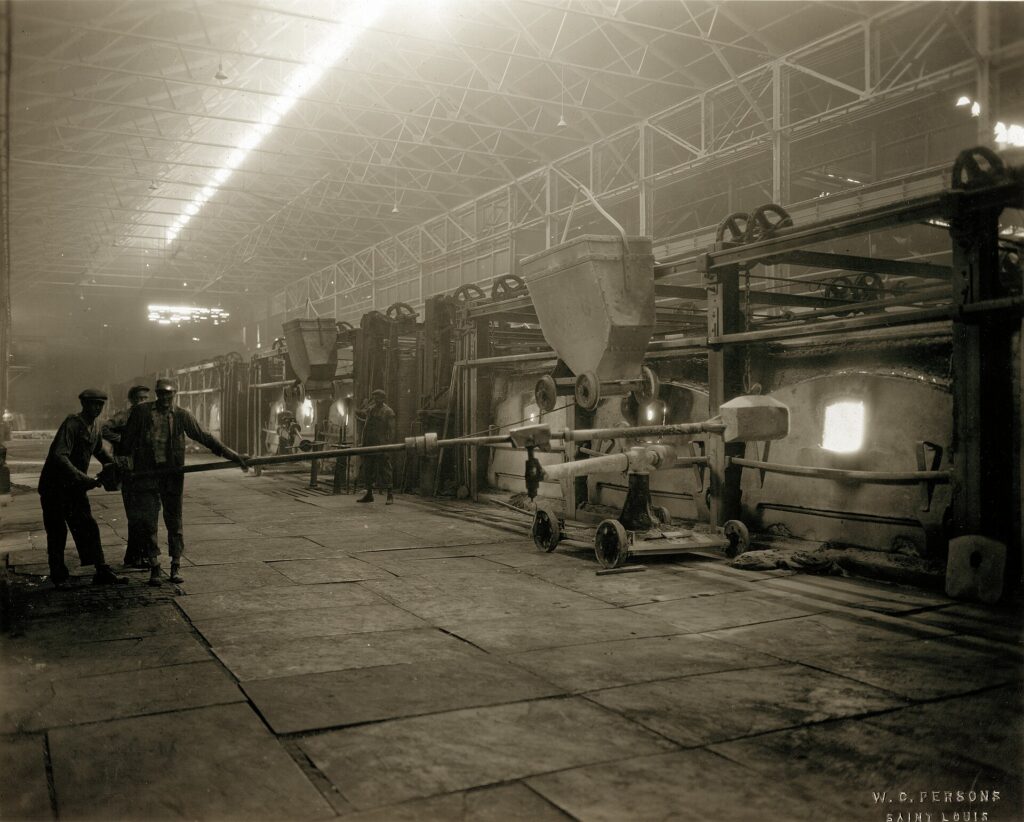
Workers prepare molten glass for pouring at the Pittsburgh Plate Glass Company in 1919. Photo courtesy of the Missouri History Museum and available in the public domain.
The Glass Behind American Innovation: 250 Years of American Progress
Glass is easy to overlook because its purpose is often to disappear. A good window allows us to focus on the view. A clear windshield helps us watch the road. A telescope mirror directs our attention toward distant galaxies rather than the material making the view possible.
That transparency can hide the amount of science, manufacturing expertise and human labor behind each product. Glassmakers control chemical composition, temperature, forming methods, coatings and cooling rates to create materials with very different capabilities. The glass used in a casserole dish must withstand heat. Automotive glass must protect passengers. Optical fiber must guide light across enormous distances without losing the information it carries.
When I think about the history of American glass, that versatility stands out most. The material did not support one period of innovation and then become obsolete. It repeatedly adapted to the next challenge.
From the Furnace to the American Home
American glass production expanded alongside the country’s industrial growth. Large furnaces, improved forming equipment and more dependable manufacturing methods allowed companies to produce glass at greater scale. That helped make windows, bottles, lighting and household products more widely available.
Corning’s early work included developing the glass enclosure for Thomas Edison’s incandescent lamp and a manufacturing process that helped make electric light bulbs more accessible. The company later applied its understanding of heat-resistant glass to laboratory products and cookware.
These advances changed ordinary life. Electric lighting extended the useful hours of the day. Better windows brought sunlight into factories, schools and homes. Durable glass containers improved the storage of food, medicine and other goods.
The early factory photograph above also reminds us that innovation does not happen only in research laboratories. It depends on furnace operators, skilled tradespeople, engineers, maintenance teams and production workers who know how to turn a promising formula into a reliable product.
Glass at the American Table
In 1915, Corning Glass Works perfected a borosilicate glass formula for the Pyrex brand. Unlike ordinary household glass of the period, the material could better withstand sudden temperature changes. It gave families cookware that could move from the oven to the table while allowing them to see the food inside.
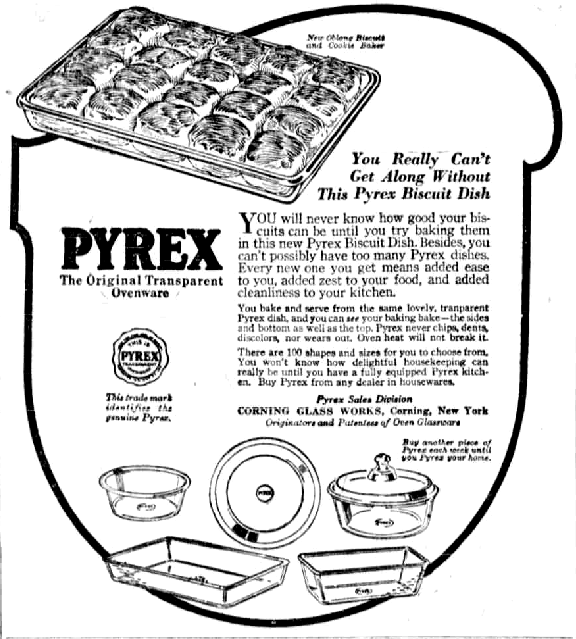
A 1922 newspaper advertisement featuring Pyrex baking dishes. The original advertisement is in the public domain.
Pyrex became more than a successful product. It demonstrated how materials research could solve a familiar problem in a practical way. By 1919, more than four million Pyrex dishes were already being used in American kitchens.
That is an important part of The Glass Behind American Innovation. Progress does not always arrive as a dramatic machine or a major scientific announcement. Sometimes it is a pie plate that handles heat more safely, lasts for years and becomes part of a family’s daily routine.
Making Transportation Safer
Early automobiles were often open vehicles, but windshields began appearing during the first decade of the 1900s. Unfortunately, the large sheets of plate glass used in early vehicles could break into sharp pieces during a crash. The windshield might protect passengers from weather and road debris, but it could become a serious hazard on impact.

A vehicle windshield photographed by Dorothea Lange near Sacramento, California, in 1936. Library of Congress photograph with no known publication restrictions.
Laminated glass offered a better solution. It placed a bonding material between layers of glass so the broken pieces were more likely to remain attached after an impact. The technology evolved through years of experimentation, including improvements to the interlayer that helped prevent discoloration and increased durability.
In 1939, several American glass and chemical companies invested heavily in the development of polyvinyl butyral, commonly called PVB. It remains a standard interlayer for laminated automotive glass.
Modern automotive glazing continues to advance. Windshields can now incorporate acoustic layers, solar-control coatings, antennas, cameras, sensors and displays. The surface in front of a driver is no longer just a barrier against wind. It is becoming part of the vehicle’s safety and information system.
This evolution is another example of The Glass Behind American Innovation working quietly in the background. Drivers may notice a windshield only when it becomes chipped, yet decades of glass science help protect them every time they enter a vehicle.
Glass in Defense and National Security
Precision glass has also played an important role in American defense. During World War I and the decades that followed, laminated safety glass was adapted for military goggles, aircraft windshields, tank windows, submarine applications and battleship bridge windows. The need to protect people while preserving a clear field of view pushed manufacturers to develop better materials and production methods.
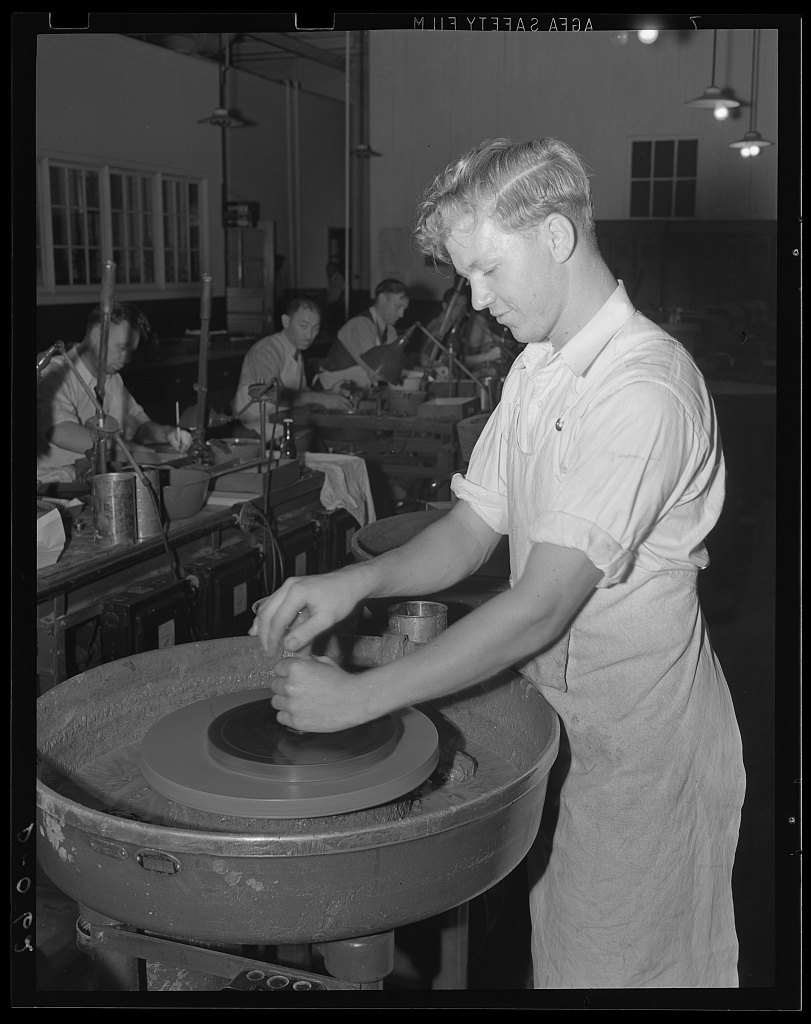
A worker performs the rough grinding of optical glass for military aiming equipment at an American arsenal around 1942. Photo from the Library of Congress.
Optical glass used in sights, rangefinders and other instruments required far more than basic transparency. The material had to bend and direct light accurately. Small imperfections could distort an image or reduce the effectiveness of the equipment.
This work strengthened America’s expertise in optics, coatings and precision manufacturing. Many of those capabilities later supported advances in scientific instruments, medical equipment, cameras, telecommunications and space exploration.
Looking Beyond Earth
Few examples demonstrate the potential of glass as clearly as the Hubble Space Telescope. Hubble’s primary mirror is a 2.4-meter disk made from Ultra-Low Expansion Glass developed by Corning Glass Works. The material was selected because it resists changes in shape as temperatures fluctuate—a critical requirement for a telescope that must focus light with extraordinary precision.

The Hubble Space Telescope after being captured by the Space Shuttle Atlantis during a 2009 servicing mission. NASA image.
Hubble has helped scientists study the age of the universe, observe distant galaxies and better understand the life cycles of stars. Behind those discoveries is a carefully engineered piece of glass that had to be formed, polished and coated with exceptional accuracy.
The telescope represents The Glass Behind American Innovation at its most ambitious. The same broad family of materials used for windows and household products can be engineered to help humanity study objects billions of light-years away.
Carrying Information at the Speed of Light
In 1970, Corning researchers developed the first commercially viable low-loss optical fiber. The breakthrough made it possible to send light signals over long distances with limited signal loss, creating a foundation for modern telecommunications.
Optical fiber is thinner than many people realize, but its impact is enormous. Fiber networks connect neighborhoods, businesses, data centers and continents. They support video calls, streaming, cloud computing, medical data, financial systems and the growing amount of information moving through the internet.
This is one of the clearest examples of glass becoming something far more advanced than a window or container. Instead of simply allowing light to pass through, optical fiber carefully guides it. Information is converted into light pulses, transmitted through the glass and converted back into usable data.
Building More Efficient American Homes
Glass innovation is also changing the amount of energy needed to heat and cool buildings. Traditional single-pane windows allow considerable heat transfer. Modern insulated glass units, multiple panes and low-emissivity coatings help reduce that loss while continuing to provide natural light.
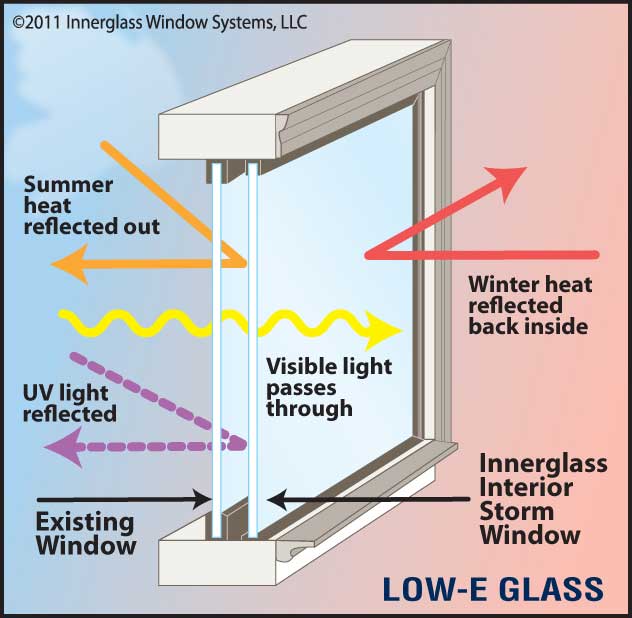
Low-emissivity glass uses a thin coating to reflect infrared heat while allowing visible light to pass through.
Low-emissivity, or low-e, coatings are extremely thin layers applied to glass. During winter, they can help reflect heat back into a building. During warmer conditions, properly selected glazing can reduce unwanted heat entering from outside.
The U.S. Department of Energy reports that low-e storm windows may reduce heating and cooling costs by approximately 10% to 30%, depending on the home and climate. These technologies show that a window can do more than separate the indoors from the outdoors. It can become an active part of a building’s energy strategy.
Continuing the Work
Glass has helped Americans light their homes, prepare food, travel safely, defend the country, communicate instantly and explore space. Its value comes from a rare combination of qualities: it can be transparent, chemically stable, heat resistant, formable, recyclable and precisely engineered.
The next generation of glass may include stronger vehicle displays, more efficient windows, thinner electronic devices, advanced medical containers, higher-capacity fiber networks and new optical systems for space. Researchers are also exploring vacuum-insulated glazing, transparent barriers and other technologies that could improve building performance without sacrificing natural light.
As America reflects on 250 years of invention and manufacturing, the glass industry deserves a prominent place in that story. The Glass Behind American Innovation is not one product or one company. It is the work of generations of people who learned to shape a familiar material into something the country needed next.
To explore more milestones, visit Corning’s official history of glass innovation.
 JOIN GMIC