From the Furnace to the Future: Celebrating Glass This Manufacturing Month
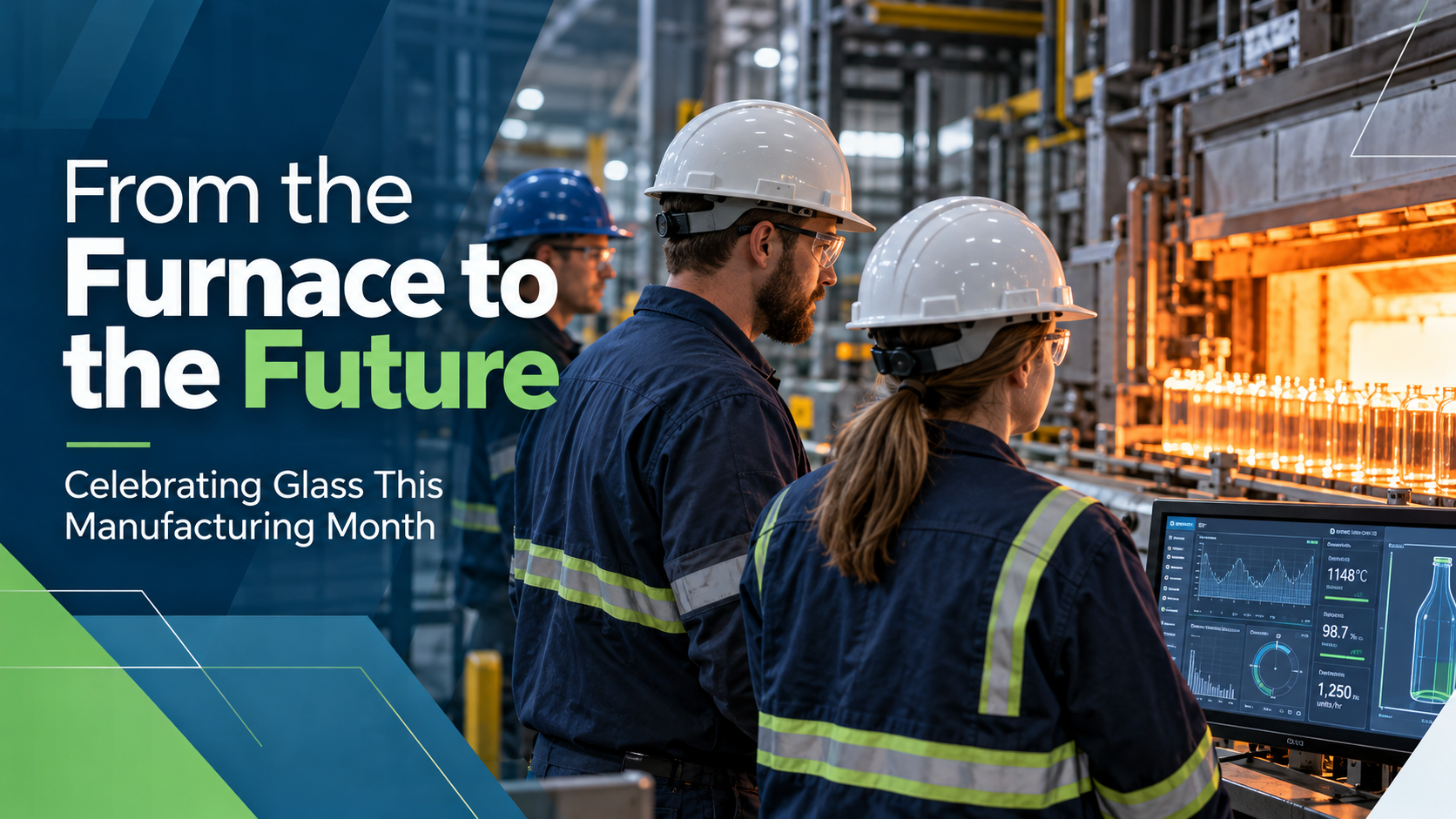
Manufacturing Month is a chance to recognize the people, technology, and progress behind one of the world’s most important materials.
For the glass industry, that story starts at the furnace. Every bottle, window, fiberglass product, architectural panel, and specialty glass application begins with raw materials transformed by heat. But the furnace is only one part of the story. Behind every production line are skilled operators, engineers, technicians, researchers, maintenance teams, suppliers, and manufacturers working together to keep the industry moving forward.
That is what makes Manufacturing Month worth celebrating. It is a time to recognize what glass manufacturing contributes today while also looking at what comes next.
A Strong Manufacturing Industry Starts With People
The U.S. glass industry employs nearly 78,000 people, according to GMIC’s Glass Manufacturing Industry Report.
Those jobs span every part of the industry, from container and flat glass to fiberglass and specialty glass. They also extend into the companies and organizations that support glass manufacturing through engineering, refractories, combustion systems, process controls, raw materials, research, automation, and technical services.
The workforce is changing, too. Modern glass plants increasingly rely on advanced sensors, digital controls, data analysis, automated systems, and predictive maintenance tools. That means the skills required in glass manufacturing are evolving alongside the technology.
Operators still need a deep understanding of the furnace and process. Engineers still need to know how glass behaves under changing conditions. Maintenance teams still need practical experience. The difference is that they now have more information and better tools to work with.
That combination of experience and technology is becoming one of the industry’s greatest strengths.
Better Visibility Is Changing How Plants Operate
One of the clearest trends in modern glass manufacturing is better visibility into the production process.
Manufacturers can now monitor furnace conditions, temperatures, glass levels, equipment performance, and other operating variables in ways that were not possible years ago. That matters because small problems can quickly become expensive ones in glass production.
A temperature change, equipment issue, or developing furnace condition can affect quality, efficiency, maintenance needs, and production reliability. The earlier a problem is identified, the more options a plant has to respond.
This was a major theme at the 87th Glass Problems Conference and the 2026 GMIC/GlassTrend Symposium. Industry discussions focused on furnace monitoring, sensors, controls, predictive maintenance, artificial intelligence, refractory performance, process optimization, and other technologies that help manufacturers better understand what is happening inside their operations.
The goal is not technology for technology’s sake. The goal is better decisions.
Better data can help maintenance teams respond earlier. Better monitoring can reduce operational risk. Better controls can support more consistent production.
The furnace remains at the center of glass manufacturing, but the ability to understand and manage that furnace is improving quickly.
The Furnace of the Future Will Need to Do More
At the same time, manufacturers are being asked to improve efficiency, reduce emissions, increase recycled content, and maintain product quality.
Those goals are closely connected. Glass melting requires significant energy, which makes furnace technology one of the most important areas of innovation in the industry.
Manufacturers and researchers are exploring electric melting, hybrid furnace systems, alternative fuels, improved combustion, better heat recovery, advanced refractories, and more efficient furnace designs.
GMIC is directly involved in that work. A U.S. Department of Energy-funded project led by GMIC is studying advanced electric melting for commercial glass production. The research is focused on practical challenges such as glass quality, furnace life, colored glass production, and the ability to apply new technologies under real manufacturing conditions.
That last point is critical. A technology may look promising in theory, but glass manufacturers have to consider much more than energy use alone.
Any new furnace technology must also support product quality, safety, reliability, production capacity, maintenance requirements, and long-term operating costs. The future of glass manufacturing will depend on finding solutions that balance all of those needs.
Recycling Is Part of the Manufacturing Process
Recycling is another important part of that future.
Glass can be recycled repeatedly, but getting recycled glass back into the furnace requires the right collection, sorting, processing, and transportation systems. For manufacturers, cullet quality matters.
Clean, furnace-ready cullet can help reduce the amount of virgin raw material needed and can also lower the energy required during melting. Contamination, inconsistent supply, and regional differences in recycling systems can make that more difficult.
This is why recycling is not simply an environmental conversation. It is a manufacturing conversation.
Improving cullet availability and quality can directly affect furnace efficiency, raw material use, energy consumption, and overall production. That connection between recycling, energy, and manufacturing will continue to be an important focus for the industry.

Recognizing the People Moving Glass Forward
Manufacturing Month is also a chance to recognize the individuals behind the progress.
GMIC’s awards program highlights professionals who are making meaningful contributions through innovation, manufacturing excellence, leadership, and technical expertise.
In 2026, GMIC recognized Katherine Rossington, PhD, of Corning Incorporated with the Glass Manufacturing Excellence Award, Aaron Huber, PhD, of Johns Manville with the Glass Innovator Award, and Quinn Imrie of Ardagh Group with the Women in Glass Award.
Their work represents something that happens throughout the glass industry every day.
Progress is often built through small improvements: a better furnace design, a safer procedure, a new monitoring system, a more reliable refractory, a better way to train employees, a new material, or a process change that reduces defects.
Those improvements are what keep manufacturing moving forward.
From the Furnace to the Future
The glass industry has always combined tradition with innovation.
The basic process of melting raw materials into glass has existed for centuries, but the technology surrounding that process continues to evolve. Today’s plants are more connected, more data-driven, and more technically advanced than ever before.
Tomorrow’s plants may rely on different energy sources, smarter monitoring systems, more advanced automation, and new approaches to recycling and furnace design. But the people behind the process will remain just as important.
Manufacturing Month is an opportunity to celebrate both sides of that story.
It is about recognizing the skilled workforce producing glass today and the engineers, researchers, manufacturers, and technology providers building what comes next.
From the furnace to the future, glass manufacturing continues to evolve. GMIC is proud to help bring the industry together to share knowledge, solve challenges, and move glass manufacturing forward.
Explore more data and insights from the GMIC Industry Report:
https://gmic.org/industry-report-public/
 JOIN GMIC